

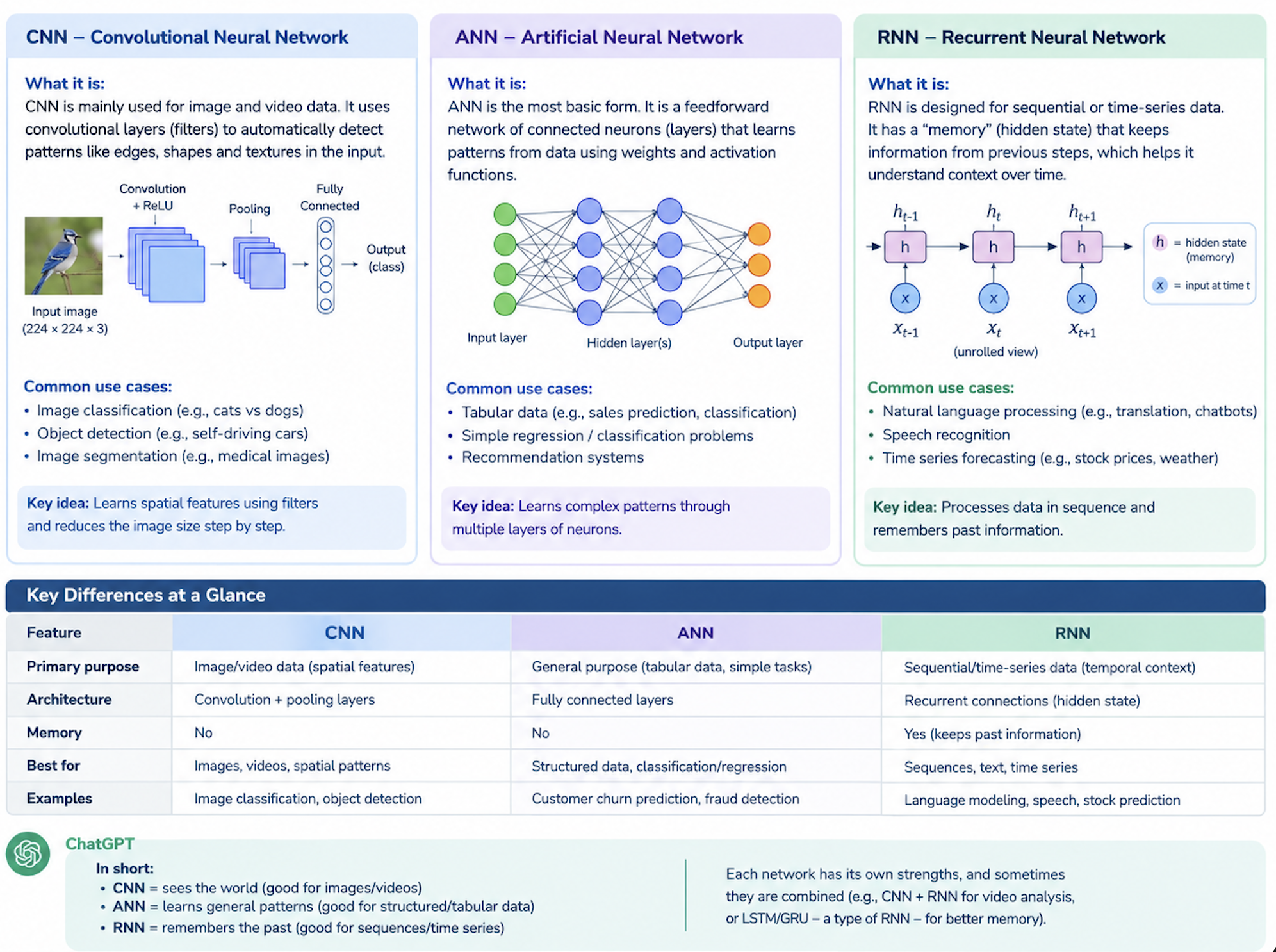
ANN (Artificial Neural Network)
- Structure: Fully connected layers where each neuron connects to every neuron in the next layer.
- Best for: Tabular data, classification, regression, and general-purpose tasks.
- How it works: Takes flattened input → processes through hidden layers → produces output.
- Weakness: Doesn’t preserve spatial or sequential relationships; treats all inputs equally.
- Example: Predicting house prices from features like size, location, bedrooms.
CNN (Convolutional Neural Network)
- Structure: Uses convolutional filters (kernels) that slide across input to detect local patterns, followed by pooling layers for dimensionality reduction.
- Best for: Image and spatial data (computer vision).
- How it works: Filters detect edges, textures, shapes → hierarchical feature extraction → classification.
- Key advantage: Spatial awareness—learns that nearby pixels are related; weight sharing reduces parameters.
- Example: Image recognition (cats vs. dogs), object detection, medical imaging.
RNN (Recurrent Neural Network)
- Structure: Has loops/memory cells that pass information across time steps; maintains hidden state between inputs.
- Best for: Sequential and time-series data.
- How it works: Process input at each time step, update hidden state, use it for next step.
- Key advantage: Captures temporal dependencies and long-range patterns.
- Variants: LSTM and GRU address the vanishing gradient problem for longer sequences.
- Example: Language modeling, machine translation, stock price prediction, speech recognition.
CNN, ANN and RNN – Study Notes
1. Artificial Neural Network (ANN)
ANN (Artificial Neural Network) is the basic form of a neural network. It consists of interconnected neurons arranged in layers.
Basic structure
Input Layer → Hidden Layer(s) → Output Layer
Each neuron receives inputs, applies weights and an activation function, and passes the result to the next layer.
How ANN works
- Input data is provided to the input layer.
- Data passes through one or more hidden layers.
- Each connection has a weight.
- The network learns by adjusting these weights during training.
- The output layer produces the final prediction.
Common applications
- Classification
- Regression
- Customer churn prediction
- Fraud detection
- Sales prediction
- Tabular/structured data
Key idea
ANN learns general patterns by connecting neurons through multiple layers.
2. Convolutional Neural Network (CNN)
CNN (Convolutional Neural Network) is a neural network designed primarily for images and other spatial data.
Instead of treating every pixel independently, CNN uses convolution filters to detect important features.
Basic structure
Input Image → Convolution → Activation → Pooling → Fully Connected → Output
How CNN works
Step 1 – Convolution
Small filters move across the image and detect features such as:
- Edges
- Lines
- Corners
- Textures
- Shapes
Step 2 – Activation
An activation function such as ReLU introduces non-linearity into the network.
Step 3 – Pooling
Pooling reduces the spatial size of the feature maps while retaining important information.
Step 4 – Fully Connected Layer
The extracted features are combined to make the final prediction.
Common applications
- Image classification
- Face recognition
- Object detection
- Medical image analysis
- Image segmentation
- Video analysis
Key idea
CNN learns spatial features from an image using filters.
For example:
Pixels → Edges → Shapes → Objects → Classification
3. Recurrent Neural Network (RNN)
RNN (Recurrent Neural Network) is designed for sequential data, where the order of information is important.
Unlike a basic feed-forward ANN, an RNN maintains a hidden state that carries information from previous steps.
Basic concept
Input₁ → RNN → Output₁
↓
Input₂ → RNN → Output₂
↓
Input₃ → RNN → Output₃
The information from the previous step can influence the next step.
Example
Consider the sentence:
“I live in New York.”
When processing the word “York”, the RNN can use information from the earlier words to understand the context.
Common applications
- Natural language processing
- Text prediction
- Speech recognition
- Machine translation
- Time-series forecasting
- Sequence analysis
Key idea
RNN processes information sequentially and uses information from previous steps.
4. CNN vs ANN vs RNN
| Feature | ANN | CNN | RNN |
|---|---|---|---|
| Full name | Artificial Neural Network | Convolutional Neural Network | Recurrent Neural Network |
| Main purpose | General-purpose learning | Spatial pattern recognition | Sequential pattern recognition |
| Best suited for | Structured/tabular data | Images/video | Text/time-series/sequences |
| Special mechanism | Fully connected neurons | Convolution filters | Recurrent/hidden state |
| Understands spatial relationships | Limited | Yes | Not its main purpose |
| Uses previous-step information | No | No | Yes |
| Typical input | Features/numbers | Images/grids | Ordered sequences |
| Example | Fraud classification | Cat vs dog image | Text prediction |
5. Simple Real-World Example
Imagine we want to build three different AI systems.
Problem 1: Identify whether an image contains a cat
Use CNN.
Image → CNN → Features → Cat/Dog
CNN is good because it can learn visual features such as ears, eyes, fur and shapes.
Problem 2: Predict whether a customer will leave a company
Use an ANN for a typical structured-data problem.
Age + Salary + Tenure + Usage → ANN → Churn/No Churn
ANN can learn relationships between these input features.
Problem 3: Predict the next word in a sentence
Use an RNN or a more modern sequence architecture.
“I am going to…” → RNN → “school”
The order of previous words matters, so sequential processing is useful.
6. Easy Way to Remember
Think of them like this:
ANN = General Learner
“Give me features, and I will learn the relationship.”
CNN = Vision Specialist
“Give me an image, and I will find spatial patterns.”
RNN = Sequence Specialist
“Give me a sequence, and I will use previous information.”
7. Important Relationship
CNN, ANN and RNN are not completely unrelated technologies.
A CNN can contain fully connected layers.
An RNN is also built using neural-network components.
So a useful way to think about them is:
ANN → General neural-network architecture
CNN → Specialized for spatial data
RNN → Specialized for sequential data
8. One-Line Interview Answer
If asked in an interview:
ANN is a general-purpose neural network, CNN is specialized for spatial data such as images, and RNN is designed for sequential data where previous information can influence the current output.
Memory Trick
ANN → Any structured data
CNN → Computer Vision
RNN → Remember the sequence


